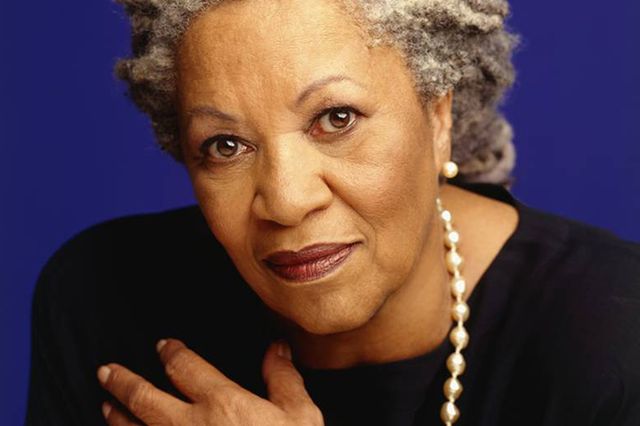
Morrison was born Chloe Ardelia Wofford in Lorain, Ohio, in 1931. She earned her bachelor’s degree in English in 1953 from Howard University, and her master’s, also in English, in 1955 from Cornell University. After teaching for some years, she began working as an editor for Random House, where she rose to become Senior Editor of the fiction department. From that position, she championed the publication of many African and African American writers, including Chinua Achebe, Wole Soyinka, and Toni Cade Bambara. She published her first novel, The Bluest Eye, in 1970. A stream of highly acclaimed novels followed, including Beloved, considered by many her masterpiece, which in 1988 won both the Pulitzer Prize and the American Book Award. In 1993, Morrison was awarded the Nobel Prize for Literature. Altogether, her work as a literary artist includes 11 novels, two plays, an opera libretto, and several children’s books. Morrison is currently Robert F. Goheen Professor in the Humanities, Emerita, in the Department of African American Studies at Princeton University.
In addition to her distinguished career as a novelist, Morrison has also pursued a parallel career as a teacher, literary theorist, and cultural critic. In the latter capacity, she has published numerous essays on a wide variety of topics, and has edited a large number of volumes by other writers. Her two most important collections of essays are Playing in the Dark (see below) and The Origin of Others. She has also published monographs on topical issues of the day, including Race-ing Justice, En-gendering Poweron the Clarence Thomas/Anita Hill controversy, and Birth of a Nation’hood on the O.J. Simpson case. Morrison has also been heavily concerned with freedom of publication issues around the world, as is evidenced by another collection of writings she has edited entitled Burn This Book: PEN Writers Speak Out on the Power of the Word. Two volumes of edited conversations with her have also been published. To all of her non-fiction writing, Morrison brings the rhetorical grace, the commanding authorial voice, the profound insight into human nature, and above all the infinite capacity for empathy of a literary artist of the highest caliber.
In addition to the awards and prizes already mentioned, Morrison has won a great many other honors, both here and abroad. Her work has been very widely translated, and her achievement has been recognized with many honorary degrees and memberships in professional and national academies, both American and foreign. For instance, in 2010 she was made an Officer of the French Légion d’Honneur. In recent years, the study of Morrison’s work by other scholars has become a literary industry unto itself. In 2012, she was awarded the Presidential Medal of Freedom. In 2016, Morrison won the PEN/Saul Bellow Award for Achievement in American Fiction, while that same year she was also appointed to the prestigious Charles Eliot Norton Professorship in Poetry at Harvard University.
Publications:
- The Black Book (Random House, 1974; 35th anniversary edition, 2009)
- Playing in the Dark: Whiteness and the Literary Imagination (Harvard University Press, 1992)
- Race-ing Justice, En-gendering Power: Essays on Anita Hill, Clarence Thomas, and the Construction of Social Reality (Pantheon, 1992)
- Conversations With Toni Morrison (University Press of Mississippi, 1994)
- The Dancing Mind: Speech upon Acceptance of the National Book Foundation Medal for Distinguished Contribution to American Letters (Knopf, 1996)
- Birth of a Nation’hood: Gaze, Script, and Spectacle in the O.J. Simpson Case (Random House, 1997)
- Remember: The Journey to School Integration (Houghton Mifflin Harcourt, 2004)
- Toni Morrison: Conversations (University Press of Mississippi, 2008)
- What Moves at the Margin: Selected Nonfiction (University Press of Mississippi, 2008)
- Burn This Book: PEN Writers Speak Out on the Power of the Word (Harper, 2009)
- Race (Vintage Minis, 2017)
- The Origin of Others (Harvard University Press, 2017)